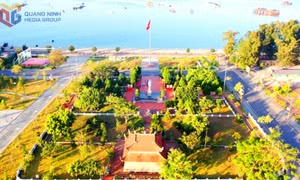
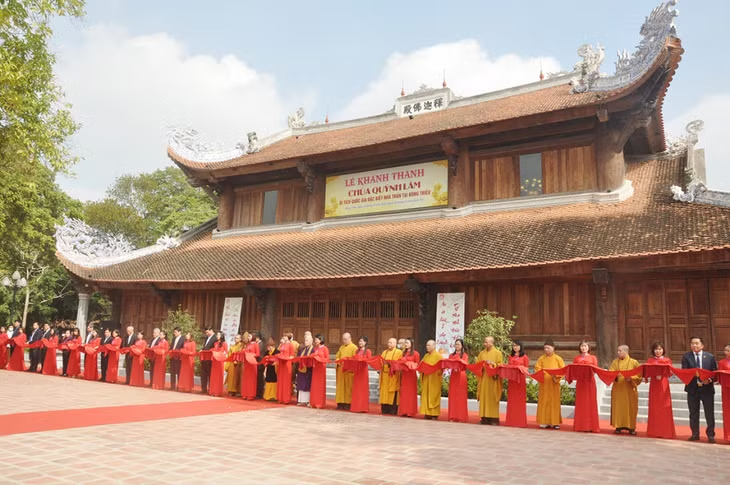
On Dec. 12, the Quang Ninh provincial Buddhist Management Board and the People’s Committee of Dong Trieu town jointly organized the inauguration ceremony of Quynh Lam Pagoda, part of the Tran Dynasty's special national relic complex in Dong Trieu.
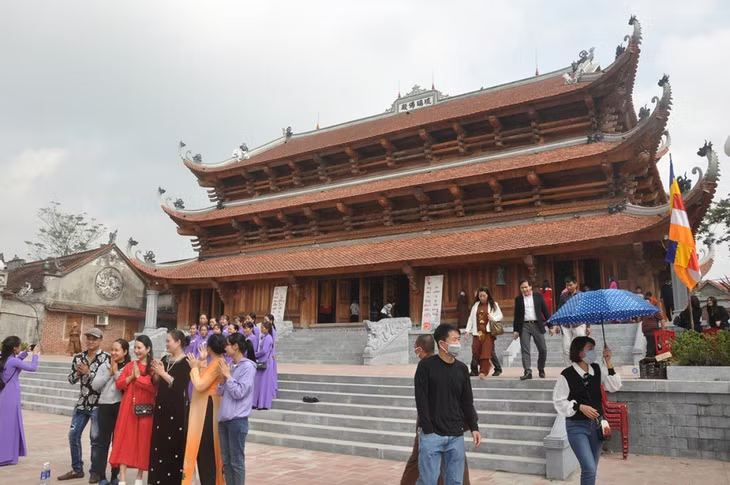
The ceremony attracted the participation of many pilgrims, locals and tourists.
Having been launched since June 2016, the project is valued at over VND 160 billion from the socialized capital source.
Currently, the first phase of the project has been completed with the investment capital of nearly VND 70 billion. It is expected to significantly contribute to better serving the locals and tourists' religious beliefs as well as protecting and promoting the values of the Tran Dynasty's special national relic sites.
Also at the ceremony, Quynh Lam pagoda granted VND 50 million to a poor household at Trang An ward to assist them in building their house.
Located at Dong Trieu district, Quynh Lam pagoda used to be the largest Buddhist center of Viet Nam during the 17th and 18th century. The pagoda was built at the Pre-Ly Dynasty (about the end of the 5th century, begin of the 6th century) and has been restored many times under the Dinh, Early Le, Ly, Tran, Le Dynasties.
Before the pagoda is a great lake, while the three remaining sides are surrounded by hills and mountains. It was embellished and completed in Ly, Tran Dynasties. During the 11th and 14th centuries, the end of Le Dynasty, and in the 17th and 18th centuries, it developed into the main centre of Buddhism for the entire country.
In the 14th century, the Quynh Lam Pagoda became an even more important Buddhist centre with the activities of the monk Phap Loa Dong Kien Cuong, a member of the second generation of the Truc Lam Buddhist sect. It was the centre for sacred books and for preaching Buddhism, as well as a training-site for future pagoda wardens. Many associations, famous in Vietnamese literature and history, were organized here.
In 1319, Phap Loa calls for blood donation from Buddhist followers to print over 5,000 copies of Dai Tang sutras, which are kept at Quynh Lam Buddhist Institute. In 1328, he had a statue of Maitreya cast. A year later, he brought a part of the bone ash of Tran Nhan Tong (the 1st patriarch of the Truc Lam Zen sect) to put into the stone stupa in Quynh Lam Pagoda.
In early 15th century, the pagoda was reduced to ruins and had to undergo many restorations. In 1727, the 7-storey Tich Quang Stupa (grave of monk Chan Nguyen, who made great contribution to the pagoda) was set up, which measures up to 10 meters. The stupa’s top takes the shape of a banyan bud. To the stupa is attached a plate which notes down the biography of monk Chen Nguyen. In mid-18th century, the pagoda underwent a major restoration. It now also has bronze bells and stone gongs.
Translated by Phuong Loan