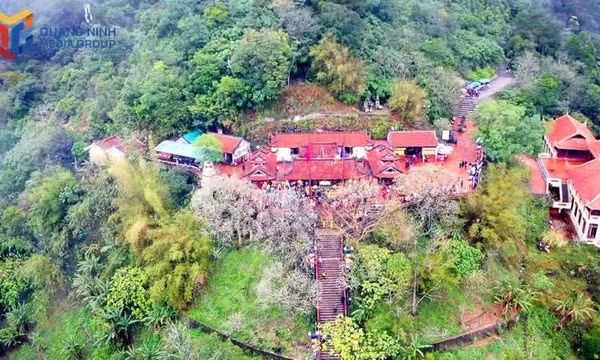
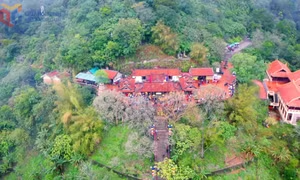
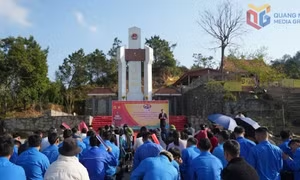
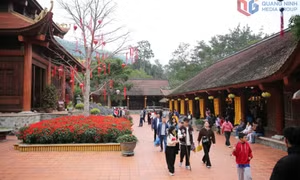
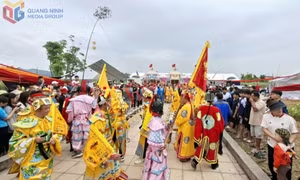
Located in Cua Ong ward, Cua Ong Temple is one of Quang Ninh’s most significant Tran Dynasty relic sites and was recognised as a special national relic site in 2017. Besides its historical and scenic values, the temple also preserves significant artistic and architectural values. Notably, it currently houses more than 30 statues honouring members of the Tran royal family and distinguished generals, along with many other valuable ritual artefacts.
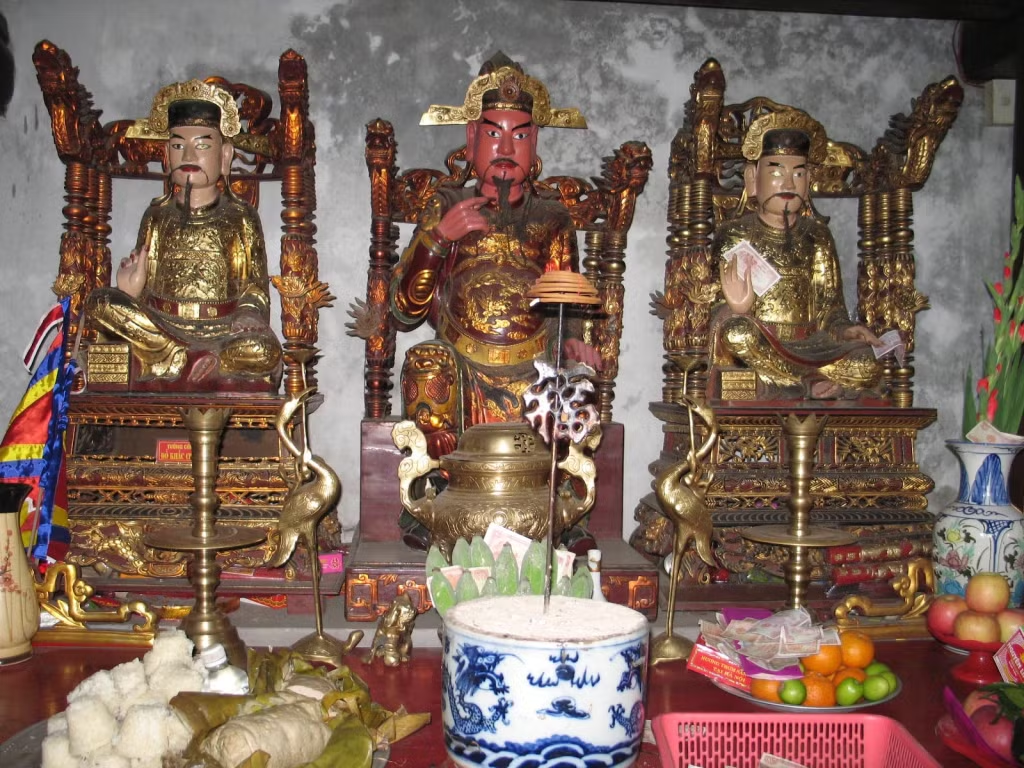
The principal deity worshipped at Cua Ong Temple is Tran Quoc Tang. Following the construction of the Lower, Middle and Upper temple complexes, other deities were also enshrined there. The Lower Temple is dedicated to the Mother Goddesses, while the Middle Temple worships Hoang Can, who helped repel northern invaders and defend the eastern sea, as well as the Mountain God and Water God. The principal deity of the Upper Temple is Grand Prince Hung Nhuong Tran Quoc Tang. Grand Commander Hung Dao Tran Quoc Tuan, his family members and generals are also worshipped there.
Based on the position of each historical figure in Tran Dynasty history, folk culture researchers have divided the statues in the Upper Temple into three main groups: members of the Tran royal family, primarily the family of Grand Commander Hung Dao Tran Quoc Tuan; and talented and virtuous individuals who contributed to national reconstruction after the war. Of the more than 30 statues, 18 have been identified by name.
The first group begins with the statue of Tran Quoc Tuan, the central figure in the second and third resistance wars against the Mongol - Yuan invaders in 1285 and 1288. The statue depicts him seated on a throne and wearing an imperial robe bestowed by the king, embossed with dragons, phoenixes, clouds and flames. Both the throne and the statue are placed inside a large shrine cabinet intricately carved with dragons and phoenixes and finished with red lacquer and gold leaf. Next is the statue of Tran Quoc Tang, the temple’s principal deity. He is portrayed seated on a throne, with a red face and wearing an imperial robe embossed with dragons and phoenixes. His left hand rests on his thigh, while his right hand holds an ivory court tablet. The statue’s overall bearing conveys the spirit of a valiant general.
The group also includes statues of Tran Quoc Tuan’s relatives: Princess Quyen Thanh, his daughter and the wife of King Tran Nhan Tong; Mother Goddess Thien Thanh, his wife and the mother of Tran Quoc Tang; and King Tran Anh Tong, Tran Quoc Tang’s son-in-law, whose statue is smaller in size.
The second group consists of Tran Dynasty generals who made major contributions during the two resistance wars against the Mongol - Yuan invaders. Among them is Le Phu Tran, who braved volleys of arrows and used a boat plank to shield King Tran Thai Tong during a retreat. He was therefore renamed from Le Tan to Le Phu Tran, signifying his service in supporting the Tran Dynasty. He was also the first Tran Dynasty envoy sent on a diplomatic mission to the Yuan court. Another is Tran Khanh Du, best known for the Battle of Van Don, where he commanded the destruction of Zhang Wenhu’s (Truong Van Ho) grain fleet in 1288.
The group also includes Do Khac Chung, who later took the surname Tran and courageously entered the camp of Yuan general Omar (O Ma Nhi) to seek a temporary halt to hostilities. Ha Dac, an official of Phu Ninh district, now part of Phu Tho province, is also represented. According to legend, he carved large arrows, planted them in trees and erected giant effigies to terrify the Yuan troops. There is also a statue of Pham Ngu Lao, a talented and virtuous general who, according to legend, was so absorbed in thoughts of national affairs while weaving a basket that he did not notice a spear piercing his thigh. Other statues depict men who were originally household servants of Tran Quoc Tuan before becoming accomplished Tran Dynasty generals, including Yet Kieu, Nguyen Dia Lo and Nguyen Che Nghia.
The final group comprises statues of those who contributed to rebuilding the country after the war, including Tran Thi Kien, Pham Ngo and Tran Quang Trieu. Tran Thi Kien was originally from Cu Sa village in Dong Trieu. Renowned for his integrity and fairness, he was once presented with an ivory court tablet by King Tran Anh Tong. Tran Quang Trieu is closely associated with Quynh Lam Pagoda and the establishment of the Bich Dong Poetry Society led by himself.
Beyond their spiritual significance, each statue is also a finely proportioned work of sculpture, featuring intricate and sophisticated carving. Other valuable objects of worship at the temple include shrine cabinets, thrones, sets of eight precious objects and incense tables dating from the Le and Nguyen dynasties in the 18th and 19th centuries. Together, they further enhance the value of the Cua Ong Temple relic site.
By Tran Minh