The Quang Ninh Museum and Library has recently received two French colonial-era bricks collected, preserved and donated by Le Quang Thai living in Viet Hung ward. The artefacts adds further material for research into the formation and development of the Mining Area during the period of French colonial coal exploitation.
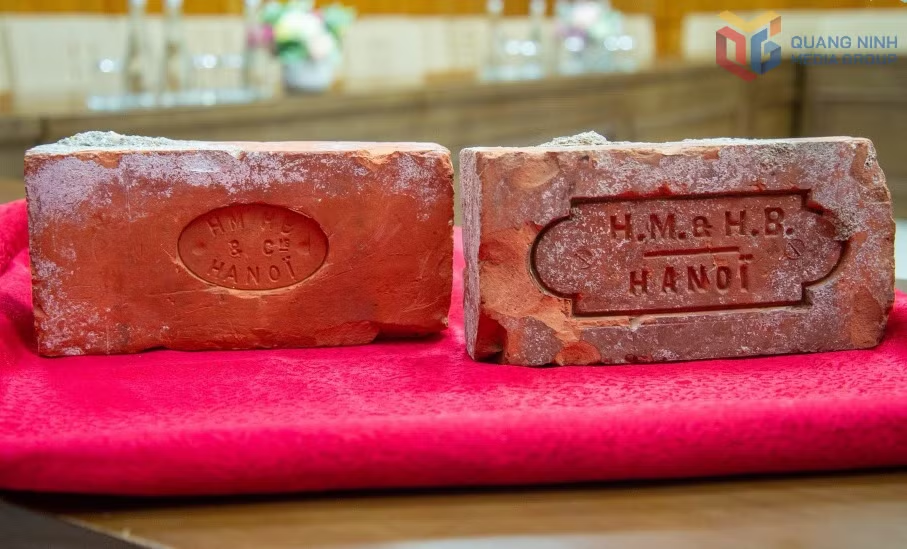
Both construction bricks remain relatively intact and are identical in size, measuring 21.5 x 10.5 x 5.5cm. Each bears the embossed abbreviation “H.M.&H.B - HANOI” on its body and is believed to date from the late 19th to early 20th century. Bricks produced during the French colonial period, commonly referred to as traditional solid bricks or French bricks, were significantly larger, thicker and heavier than standard tunnel kiln bricks used today.
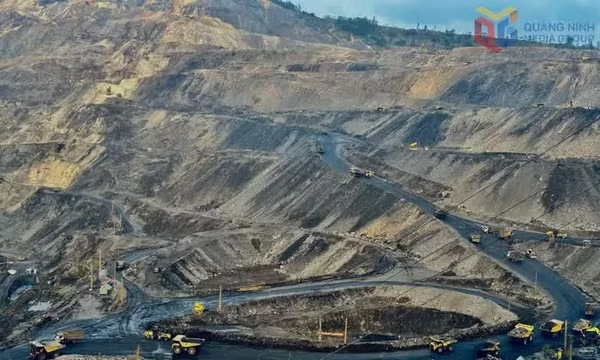
The history of French brick production and use in house construction in Quang Ninh is closely associated with the period of French colonial rule from 1883 to 1955. When the French colonialists moved into the Mining Area to exploit coal, they brought European construction materials and techniques to build numerous mansions, offices and blockhouses. To serve urbanisation and mining infrastructure needs, they required large quantities of durable construction materials for villas, administrative agency offices, housing for officials and mine owners, hospitals, post offices and warehouses.
Meanwhile, Quang Ninh possessed abundant sources of high-quality clay, including in Dong Trieu, Quang Yen, Gieng Day and Ha Tu, as well as plentiful coal reserves. The French established manual and semi-mechanised brick and tile kilns around the Mining Area to make use of local raw materials and fuel, thereby reducing transport costs from Hai Phong and Hanoi.
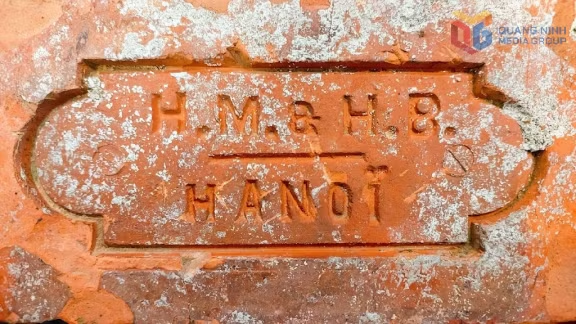
Thanks to the readily available high-calorific coal of the Mining Area, the bricks were fired at very high temperatures. The finely textured clay, fired thoroughly, produced dense bricks with a distinctive dark-red colour, a clear ringing sound when struck, substantial weight, high load-bearing capacity, effective sound insulation, and strong resistance to water penetration and the harsh coastal climate.
Today, Quang Ninh still retains many houses and office buildings constructed with bricks from the French colonial period, including the headquarters of the French Tonkin Coal Mining Company, now TKV’s Production Operations Centre in Quang Ninh; the row of buildings of the Vavasseur administrative agency; the former post office in Cam Pha, now the Cam Pha Coal Region Memorial House; the former office of a French mine owner in Hon Gai, now the headquarters of the provincial Labour Federation; and residential buildings in Quang Yen and Tien Yen.
These structures typically feature brick walls 30–40cm thick, semicircular arches and symmetrical columns in Neoclassical or Baroque styles. The thick brick walls provide effective thermal insulation, helping keep interiors cool and exteriors warm, while eliminating the need for complex reinforced-concrete frames. More than a century later, the bricks used in French colonial-era buildings in Quang Ninh have remained durable over time. In a similar way to what the French did, the later flourishing clay brick and tile industry in Quang Ninh, including in Dong Trieu and Gieng Day, also inherited and developed from the area’s geological foundation and long-standing tradition of fired building-material production.
By Pham Hoc