Amid Ha Long’s vibrant tourism scene, the return of deep-red sails after decades of absence not only evokes memories among coastal communities in Quang Ninh, but also helps preserve the heritage of traditional craftsmanship and the identity of maritime culture.
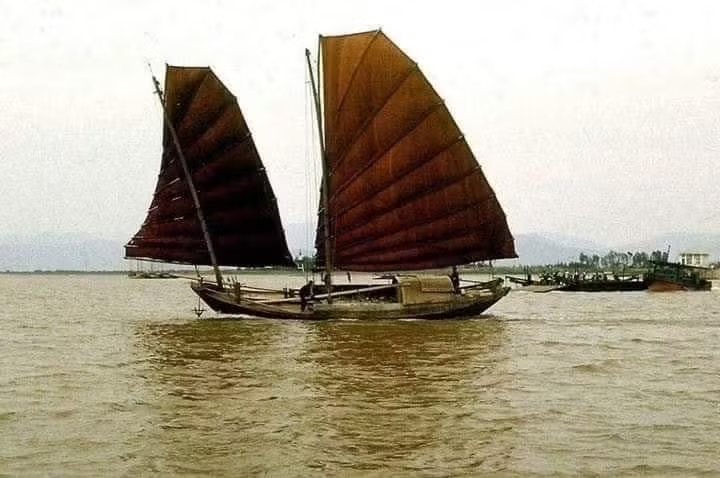
For centuries before motorised engines came into widespread use, sails were one of the main means enabling people to travel and transport goods on rivers and at sea. In Quang Ninh, fishermen learned to harness every current of wind to set sail for fishing, carry coal, rice, ceramics, fish sauce and ironwood, and connect ports within and beyond Quang Ninh.
The three-panel sailing boat is a traditional vessel using bat-wing-shaped sails, created by craftsmen in the past from three joined wooden planks, one for the bottom and two for the sides, together with a distinctive two-mast system. Though seemingly simple in design, it is highly manoeuvrable, capable of sailing downwind and across the wind, and particularly able to move forward against the wind thanks to the arrangement and adjustment of its sail system.

The sails were usually made from coarse fabric and repeatedly soaked in mangrove bark water or mud to protect them from sea salt and improve durability. Over the years, sun and wind deepened the sails into a muted, earthy tone. Each sail therefore bore its own imprint of time. The old saying was that one could tell the boatbuilder by looking at the sail. Some craftsmen never left their homeland in their entire lives, yet the sails they made travelled with the wind across the Gulf of Tonkin.

In late June 2026, a joint venture between Quang Ninh Waterway Passenger Transport Joint Stock Company and Vietnam Sightseeing Joint Stock Company launched the Ha Long three-panel sailing boat experience. This marked not only the introduction of a new tourism product, but also the return of a once-familiar image: the sails.
People’s Artisan Le Duc Chan, the 17th-generation successor of the Le family at the Cong Muong boatbuilding craft village on the Bach Dang River in Lien Hoa ward, reconstructed the three-panel sailing boat based on the original model. He also modified the vessel by adding an engine so that it could carry tourists even when there was no wind.
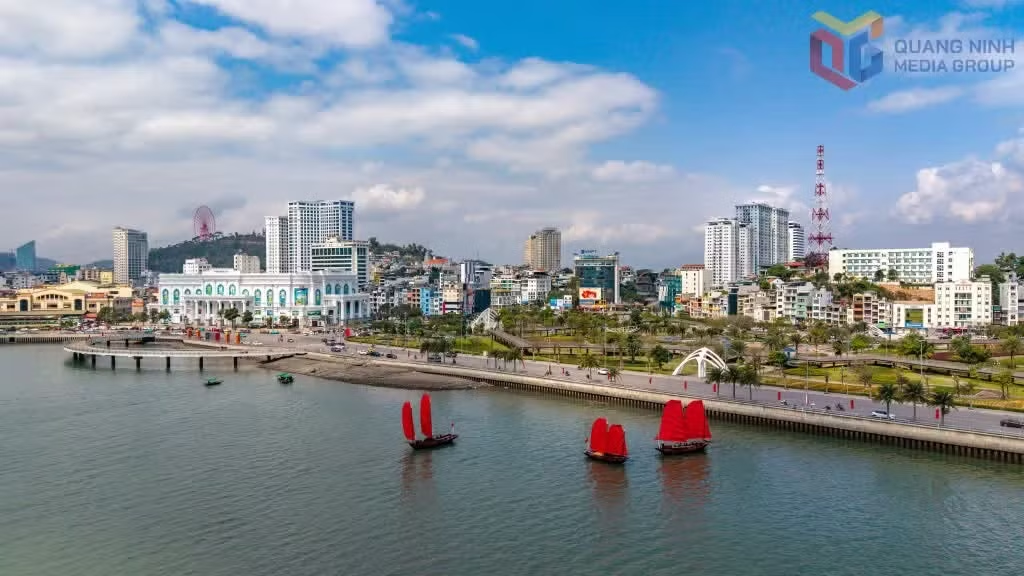
The tour runs along the shore of Ha Long Bay, from the Ha Long 1 Market area in Hong Gai ward to the Quang Ninh Museum and Library complex and back. Each trip lasts around one hour. Sailing across the bay offers visitors a distinctive experience, allowing them to feel the sea breeze, listen to the waves and immerse themselves in the cultural space of the destination.
By Pham Hoc