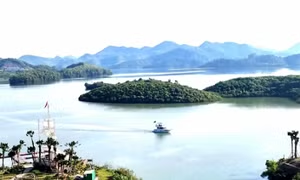
Seen as “a miniature Vietnam”, Quang Ninh is home to 600 historical and cultural sites including pagodas, temples, shrines, royal tombs, and sightseeing places, especially the world heritage site and the new wonder of the world Ha Long Bay, and the special historical relic - sightseeing site Yen Tu, which is the birth place of Truc Lam Zen Buddhism, and a spiritual tourism destination of the country.
Quang Ninh holds a very special geographical position in the country's socio-economic development strategy and the Red River Delta socio-economic development strategy as well. The Hanoi region has particularly defined the important role of Quang Ninh as a pole of the tourism-service development triangle of Hanoi, Hai Phong, and Quang Ninh.
In the regional tourism cooperation strategy, Quang Ninh has been identified as an important “chain” in tourism cooperation programs partnered by China and ASEAN, specifically the “One corridor, two belts” program and the Greater Mekong Subregion Tourism Development Program... Viewed as 'a miniature Vietnam', Quang Ninh is home to 600 historical and cultural sites including pagodas, temples, shrines, royal tombs, and sightseeing places, especially the world heritage site and the new wonder of the world Ha Long Bay, and the special historical relic - sightseeing site Yen Tu, which is the birth place of Truc Lam Zen Buddhism, and a spiritual tourism destination of the country.
Quang Ninh's tourism sector has been playing a significant role in the tourism industry of the northern key economic zone and the northern tourism area, reeling in a large number of domestic and foreign visitors and generating quite big incomes. Therefore, the health of Quang Ninh's tourism sector will contribute substantially to the growth of Vietnam's tourism industry in general and the province's socio-economic growth in particular. In 2001, Quang Ninh greeted 1.97 million visitors. In 2017, the figure hit nearly 10 million. In the meantime, around 2,000 organizations (enterprises, collectives, and household-based businesses) have engaged in tourism activities, with 23,000 direct employees and 37,000 indirect laborers.
Regarding facilities and services, at present Quang Ninh provides 19,000 lodging rooms (17,000 rooms on land and 1,900 rooms at tourist junks); over 500 tourist junks with 22,000 seats and nearly 300 cruise coaches with more than 8,000 seats. On tourism products and space, Quang Ninh has so far shaped four tourism spaces with signature products. Specifically, Ha Long city is attached to Ha Long Bay tour; Mong Cai-Tra Co is meant for border tourism; Ban Don-Co To district is associated with high-end resort - island tourism and casino activities; and Uong Bi city-Dong Trieu town-Quang Yen town area is linked to cultural and spiritual tourism, community-based services and craft village tours. In the coming years, the province defines to develop tourism in a professional, modern and effective manner, considering external resources as important and breakthrough contributing factors.
Tourism development will go along with conserving and optimizing natural advantages, protecting and preserving national identity and cultural values, keeping intact landscapes and protecting the environment. The tourism sector strives to host 15-16 million visitors, generate jobs for 130,000 people, and contribute 14-15 percent of the province’s GRDP, by 2020. It aims to turn Quang Ninh into an international tourism centre, a key national tourism destination with synchronized and modern physical facilities and a variety of high-quality outstanding tourism products that are strongly imbued with cultural identities of the ethnic groups in the province and are able to compete with that provided by other countries in the region and the world.
Article by Ngoc Lan