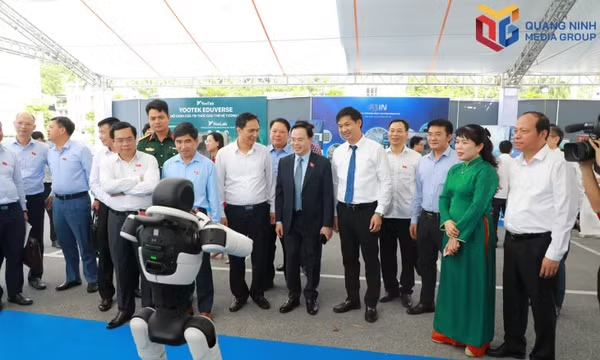
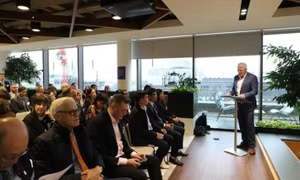
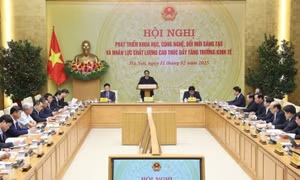
On the morning of September 23, at the Quang Ninh City Convention Centre, the Quang Ninh City People’s Committee held the 2026 Science, Technology, Innovation and Digital Transformation Forum.
Delegates discussed strategies and directions for innovation and international integration in Vietnamese higher education in the new period; promoting transnational education cooperation through international joint training programmes; and ensuring quality, credit transferability, and employability for students.
The Ministry of Science and Technology is developing a national strategy to attract and use talent, focusing on flexible mechanisms including risk acceptance in research, increased autonomy for public science organisations and benefit-sharing from research results.
Landmark directive is central to Việt Nam’s strategic goal of becoming a modern, industrialised middle-income country by 2030 and achieving high-income developed nation status by 2045.
PM Chính stressed that the advancement of science, technology, innovation and digital transformation, along with a highly skilled workforce, requires an inclusive approach that engages citizens and businesses in the process.
In 2023, Việt Nam's spending on science and technology accounted for 0.82% of the State budget’s total expenditures, including 0.23% on investment and 0.58% on regular expenditures. The rate declined from 1.01% in 2022 and 1.18% in 2017, according to the Ministry of Finance.
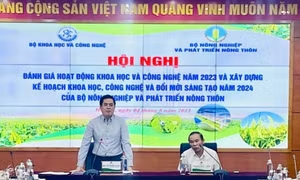
Science and technology have contributed over 30% of added value to agricultural production and 38% of added value to the production of plant varieties and livestock breeding, according to the assessment of the Ministry of Agriculture and Rural Development (MARD).
Defining the development of science, technology, and innovation as an important task in creating the foundation and driving force for agricultural development, the Ministry of Agriculture and Rural Development (MoARD) set the target of increasing the contributions of science, technology, and innovation to agricultural growth through research, transfer and application activities.